
- info@kaizendigitalhub.com
- 151/6 Panthapath Signal, Gazi Tower (2th Floor)

Kazi Law Chamber Website Redesign and SEO Case Study
29
Jul
Kazi Law Chamber Website Redesign and SEO Case Study
For a law firm, a website is not simply a digital brochure. It is often the first place a potential client evaluates the firm’s credibility, legal expertise, professional team, office locations, and ability to handle a sensitive or commercially significant matter.
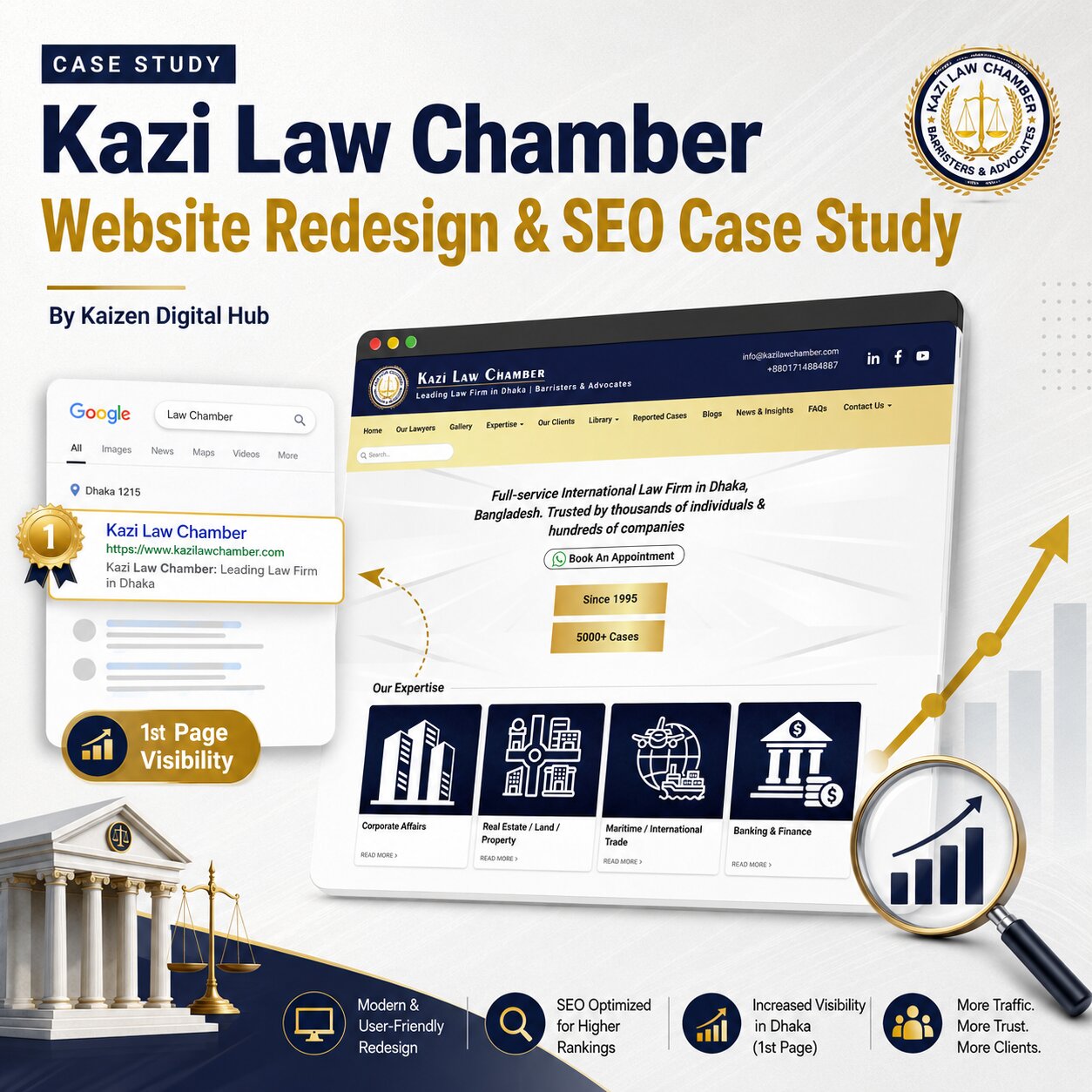
Kazi Law Chamber partnered with Kaizen Digital Hub to modernize its website, reorganize its legal content, improve the user journey, and strengthen its visibility in Google Search. The project transformed an information-heavy website into a more structured professional platform while preserving the firm’s established visual identity.
Following the website and SEO improvements, Kazi Law Chamber achieved first-page visibility on Google for the keyword “Law Chamber” in the target Dhaka location.
About Kazi Law Chamber
Kazi Law Chamber is an established legal practice based in Dhaka, Bangladesh. The firm provides legal support to individuals, companies, financial institutions, international organizations, and other professional clients.
Its areas of practice include corporate and company law, banking and finance, real estate, admiralty and maritime law, labour and employment, VAT and customs, intellectual property, dispute resolution, criminal defence, and legal matters involving charities and non-profit organizations.
This breadth of expertise is an important business strength. However, it also creates a digital communication challenge. The website must help several types of clients quickly identify the appropriate legal service without making the navigation confusing or overwhelming.
The project therefore required more than a visual update. It required a coordinated approach involving website design, content organization, user experience, local relevance, and search engine optimization.
The Challenge
Kazi Law Chamber’s previous website contained substantial information about the firm, its lawyers, practice areas, clients, reported cases, and legal publications. However, the interface and content hierarchy did not fully reflect the firm’s professional standing.
Important information was available, but visitors had to spend more time than necessary identifying the firm’s main services, understanding its experience, and finding the appropriate contact option. Large text sections reduced readability, while several important trust signals were not given enough visual prominence.
The website also had to serve audiences with very different needs. An individual looking for legal advice may search by a specific personal problem, while a company may evaluate the firm based on industry experience, professional credentials, corporate capabilities, and familiarity with Bangladeshi regulations.
International businesses may have an additional set of concerns. They may want to understand whether the firm can assist with company formation, commercial agreements, taxation, intellectual property, employment, maritime matters, or operating in Bangladesh.
The previous structure did not always provide a clear journey for each of these audiences.
From an SEO perspective, the site also needed a stronger relationship between its principal pages, practice areas, lawyer profiles, blog categories, and contact information. Without a clear information architecture, it becomes more difficult for search engines to understand which pages are most relevant to specific legal searches.
Project Objectives
Kaizen Digital Hub established four main objectives for the project.
The first was to modernize the interface while retaining the established navy, white, and gold identity associated with Kazi Law Chamber. The website needed to feel more contemporary without losing the formal character expected from a professional legal practice.
The second objective was to improve the presentation of the firm’s legal expertise. Visitors needed to understand the breadth of services while still being able to identify a specific practice area quickly.
The third objective was to make trust signals more visible. Lawyer profiles, leadership information, professional affiliations, client sectors, legal publications, office locations, and contact details needed to become prominent parts of the visitor journey.
The final objective was to strengthen the website’s SEO foundation. This required better content organization, clearer page topics, stronger local signals, improved headings, and a structure capable of supporting future practice-area pages and legal articles.
Our Website Redesign Strategy
Preserving Professional Brand Identity
The redesign retained Kazi Law Chamber’s recognizable navy and gold visual identity. Instead of replacing the brand, Kaizen Digital Hub focused on improving how that identity was applied throughout the website.
The updated interface introduced clearer section boundaries, improved spacing, more consistent typography, structured content cards, and stronger visual hierarchy. Important information can now be identified more quickly, reducing the amount of effort required from visitors.
The homepage was reorganized into a deliberate sequence. Visitors are introduced to the firm’s positioning before progressing through its background, managing partner, areas of expertise, lawyers, professional recognition, clients, legal resources, office locations, and enquiry options.
This sequence was designed around the way professional-service buyers evaluate a provider. They first assess relevance, then credibility, then expertise, and finally the practical steps required to begin a conversation.
The project demonstrates why effective web design and development services must address business communication and user decision-making rather than focusing only on visual appearance.
Improving Navigation and Content Discovery
Legal websites often contain a large volume of information. Without a clear navigation system, even valuable content can become difficult to discover.
Kaizen Digital Hub reorganized the main navigation so that users could move more easily between lawyers, expertise, clients, reported cases, blogs, news, frequently asked questions, and contact information.
The updated website also provides several paths to relevant content. A visitor can explore the firm through its main navigation, homepage practice-area sections, lawyer profiles, blog categories, client sectors, or contact options.
This is particularly important for a law firm serving both individuals and organizations. Not every visitor will arrive with the same level of legal knowledge or use the same terminology when describing a problem.
The redesigned structure allows people to begin with the topic they understand and move towards more detailed legal information.
Organizing the Firm’s Legal Services
One of the most important elements of the project was the organization of Kazi Law Chamber’s practice areas.
The updated website presents major services such as corporate law, company law, admiralty and maritime law, VAT and customs, real estate, labour and employment, banking and finance, intellectual property, dispute resolution, and criminal defence through clear visual sections.
This makes it easier for prospective clients to determine whether the firm handles their type of matter.
The content was also organized using language that can be understood by decision-makers who may not have an extensive legal background. Professional accuracy was retained, but important service categories were made easier to scan and interpret.
This approach supports both usability and SEO. Users can identify relevant services more efficiently, while search engines receive clearer signals regarding the subjects covered by the website.
As the website continues to grow, each major practice area can be supported by a dedicated service page and a group of related legal articles. This creates a scalable content structure rather than relying on one general page to rank for every legal service.
Reorganizing the Website Content
The previous website contained useful information, but its value was sometimes reduced by long paragraphs and limited visual separation.
Kaizen Digital Hub revised the content presentation so that each section had a clearer purpose. The firm overview communicates the organization’s background. Practice-area sections explain its legal capabilities. Lawyer profiles introduce the professionals behind the firm. Client sections indicate the types of organizations served, while blogs and news demonstrate ongoing professional engagement.
The homepage content was structured using descriptive headings, shorter sections, service cards, lawyer profiles, category blocks, and stronger calls to action.
This did not involve reducing complex legal services to generic advertising statements. Instead, the objective was to make the firm’s expertise easier to evaluate.
For B2B and professional-service organizations, effective content should reduce uncertainty. A prospective client should be able to understand what the firm does, whom it serves, why it may be qualified, and how to begin a conversation.
That principle guided the website’s content revision.
Strengthening Trust and Credibility
Legal services involve significant trust. A client may be preparing to disclose confidential information, protect an important asset, resolve a dispute, enter a commercial agreement, or respond to a regulatory matter.
The website therefore needed to communicate credibility through evidence rather than relying only on promotional claims.
The redesigned structure gives greater prominence to the firm’s managing partner, lawyers, professional affiliations, client sectors, reported cases, publications, and physical office locations.
These elements help potential clients assess the people and institutional experience behind the services.
The new structure also creates opportunities for future credibility improvements. Kazi Law Chamber can continue expanding lawyer biographies, professional credentials, approved client testimonials, awards, case summaries, publications, and frequently asked questions.
This is especially valuable for legal SEO. Search visibility may bring a visitor to the website, but credible information is required to move that visitor towards an enquiry.
Improving the Enquiry Journey
A professional website should make the next step clear without becoming overly promotional.
The updated Kazi Law Chamber website places appointment and contact options at important stages of the user journey. Visitors can access phone numbers, email addresses, WhatsApp, office locations, a contact form, and appointment-related calls to action.
The website also presents multiple office locations more clearly. This helps visitors understand where the firm operates and provides useful local information for people considering an in-person consultation.
By connecting legal information with practical contact options, the redesigned website creates a more direct journey from research to enquiry.
No unsupported increase in leads or conversions is being claimed in this case study. Measuring those outcomes would require validated information from website analytics, call tracking, form submissions, and the client’s internal enquiry records.
However, the revised structure was specifically designed to reduce friction and make communication options easier to find.
Our SEO Approach
The SEO work focused on improving how the website communicates its identity, services, location, and subject matter to search engines.
Page headings were aligned with relevant legal topics, and the relationships between the homepage, practice areas, lawyers, legal articles, and contact information were made clearer.
Local relevance was reinforced through consistent Dhaka location information and more visible office details. The content structure also created stronger opportunities for internal linking between legal services and supporting articles.
The blog section was organized around major legal categories such as corporate affairs, doing business in Bangladesh, maritime and international trade, labour rights, real estate, VAT and customs, banking and finance, intellectual property, and non-profit organizations.
This category structure can support a broader SEO silo over time. A primary legal-service page can be connected to related articles addressing client questions, regulatory changes, common risks, processes, and decision criteria.
For organizations considering a similar strategy, professional SEO services in Bangladesh should combine content quality, technical accessibility, internal linking, local signals, user experience, and conversion planning. Search optimization should not be treated as an isolated activity performed after the website is completed.
The Verified Google Result
Following the website and SEO improvements, Kazi Law Chamber achieved first-page visibility on Google for the keyword “Law Chamber” in the target Dhaka location.
This is significant because “Law Chamber” is a category-level search rather than a query containing the firm’s complete brand name. It provides an opportunity for the firm to be discovered by users searching more generally for a legal provider.
The result has been described conservatively and accurately. Search results can vary according to location, device, language, personalization, competition, and algorithm changes.
The evidence confirms first-page organic visibility for the stated keyword at the target location and time of verification. This case study does not claim a permanent ranking, a fixed position, a Google Maps ranking, a traffic-growth percentage, or a specific increase in enquiries without supporting data.
This distinction is important because a trustworthy SEO case study should separate an observed search result from broader commercial results that require analytics and client records.
Business Impact
The project created value beyond the visibility of a single keyword.
Kazi Law Chamber now has a more professional website that presents its legal expertise through a clearer and more structured digital experience. Visitors can identify relevant practice areas, review lawyer information, explore legal resources, find office locations, and access contact options more easily.
The website also provides a stronger platform for future content marketing. New legal articles can be published under defined categories and linked to corresponding practice-area pages. Detailed service pages can target more specific commercial searches, while lawyer biographies and professional insights can demonstrate deeper subject-matter expertise.
The improved structure supports long-term organic growth by allowing the website to develop authority around individual legal topics rather than depending entirely on the homepage.
Businesses considering a comparable project can review our guide to website development cost in Bangladesh to understand how content volume, custom functionality, design requirements, and long-term scalability affect project investment.
Organizations evaluating ongoing search optimization can also explore our guide to SEO cost in Bangladesh.
Why the Project Worked
The Kazi Law Chamber project was effective because website design, content strategy, user experience, and SEO were treated as one connected system.
A visual redesign alone would not have resolved the content-structure problem. SEO adjustments without credible lawyer and service information could have attracted visitors without creating sufficient confidence. Content revision without improved navigation would still have made information difficult to discover.
By addressing these areas together, Kaizen Digital Hub helped translate Kazi Law Chamber’s professional experience into a more accessible digital presence.
The project also respected the nature of the client’s industry. The objective was not to make an established law firm resemble a consumer brand or technology startup. The design was modernized while retaining the authority and formality appropriate for legal services.
Opportunities for Continued Growth
The redesigned website provides a stronger foundation, but sustainable SEO requires continued development.
Future opportunities include creating detailed pages for priority practice areas, expanding lawyer biographies, publishing authoritative legal guides, adding structured data, improving page-speed performance, strengthening Google Business Profile optimization, and measuring calls and form submissions.
The firm can also develop legal content clusters around its most important services. For example, a corporate law page could be supported by articles about company formation, foreign investment, shareholder agreements, compliance, taxation, and doing business in Bangladesh.
This structure would allow each article to answer a specific search need while directing qualified visitors towards the appropriate legal service.
The principles behind this approach are also discussed in our local SEO checklist for Dhaka businesses, covering location signals, business information, content, reviews, citations, and conversion measurement.
Conclusion
The Kazi Law Chamber project demonstrates how an established professional-services firm can strengthen its digital presence through coordinated website redesign, content revision, and SEO.
Kaizen Digital Hub updated the website interface, reorganized its legal services, improved content discovery, highlighted important credibility signals, and created clearer contact paths.
The project also produced a verified first-page Google result for “Law Chamber” in the target Dhaka location, while establishing a scalable foundation for future practice-area pages, legal articles, and local SEO development.
Explore the shorter Kazi Law Chamber portfolio case study or contact Kaizen Digital Hub to discuss a website and SEO strategy for your professional-services organization.