- info@kaizendigitalhub.com
- 151/6 Panthapath Signal, Gazi Tower (2th Floor)

Facebook Ads Cost in Bangladesh: Budget, CPC, CPM and Management Fees
23
Jul
Facebook Ads Cost in Bangladesh: Budget, CPC, CPM and Management Fees
The Facebook ads cost in Bangladesh cannot be represented by one fixed CPC, CPM or monthly package. A Dhaka-based restaurant promoting a seasonal offer, an e-commerce brand selling nationwide and a B2B company seeking qualified decision-makers may all use Meta advertising, but their campaign economics will be substantially different.
Facebook advertising costs are influenced by the campaign objective, audience size, competition, placement, creative quality, offer, conversion path and the likelihood that the selected audience will complete the intended action. The value of the customer also matters. A company selling a high-margin professional service can usually tolerate a higher acquisition cost than a retailer earning a small profit from each order.
Businesses should therefore avoid asking only, “How much should we spend on Facebook ads?”
Management should ask what outcome the campaign must produce, how many leads or purchases are required, what percentage of those conversions become profitable customers and how much the company can sustainably invest to acquire them.
Quick answer: Published 2026 Bangladesh advertising guides show broad planning ranges of approximately BDT 5–40 per click and BDT 80–300 per 1,000 impressions for many campaigns. Lead-generation costs may range from roughly BDT 150–800, while e-commerce purchase costs may begin around BDT 350 and exceed BDT 1,500 depending on the product, audience and season. These are market estimates rather than official Meta benchmarks, and actual results can fall outside the ranges.
Facebook Ads Cost in Bangladesh at a Glance
A complete Meta advertising budget normally contains more than the amount spent inside Ads Manager. The business may also need campaign management, designs, videos, landing-page improvements, catalogue management and conversion tracking.
Cost Component Indicative Planning Range What It Covers Monthly ad spend BDT 10,000–200,000+ Delivery across Facebook, Instagram and other eligible Meta placements CPC BDT 5–40+ Average cost for a link or selected click CPM BDT 80–300+ Cost to generate 1,000 impressions Cost per lead BDT 150–800+ Lead form, message, call or website enquiry Cost per purchase BDT 350–1,500+ Completed e-commerce order Management fee BDT 5,000–25,000+ Strategy, setup, optimisation and reporting Basic monthly creative support BDT 3,000–15,000+ Static graphics, copy and limited variations Advanced creative production Custom quotation Photography, UGC-style content, animation and video
The broad ranges overlap because agencies define their deliverables differently. One BDT 15,000 package may include only campaign setup and occasional optimisation. Another may include audience research, several campaigns, creative testing, Pixel implementation, reporting and weekly analysis.
Published local pricing guides generally position smaller management retainers between approximately BDT 5,000 and BDT 25,000 per month, with media spend and creative production usually treated separately. More complex accounts involving several brands, markets, product catalogues or funnel stages may require a higher quotation.
What Are You Actually Paying for?
The term “Facebook ads budget” is often used to describe several different expenses. This can make agency quotations difficult to compare.
A professional proposal should separate each cost clearly.
Meta Advertising Spend
Ad spend is the money used to deliver advertisements through Meta’s advertising system. Depending on the campaign configuration, advertisements may appear across Facebook, Instagram, Messenger and other eligible Meta placements.
The business controls the approved budget, but Meta’s delivery system determines how it is allocated across eligible opportunities. The campaign objective tells the system which outcome to prioritise, such as awareness, traffic, leads or sales. Meta then attempts to find people who are more likely to complete the action connected to that objective.
The advertising budget should normally be paid through an account owned by the business. The client should retain administrative access to the ad account, billing history, Pixel or dataset, Page and Business Portfolio.
Agency Management Fee
The management fee pays for the professional work required to build, operate and improve the campaigns.
The scope may include business discovery, audience research, campaign architecture, placement selection, copywriting, creative coordination, tracking, budget allocation, optimisation and reporting.
A higher management fee is not automatically better. However, an unusually low fee may not provide enough specialist time for testing, reporting and ongoing creative development.
Creative Production Cost
Meta advertising is highly dependent on the quality and relevance of the creative.
Static designs may be sufficient for a focused local campaign. An e-commerce or consumer brand may require product photography, short-form videos, carousel assets, testimonial content and several variations for continuous testing.
Creative cost should therefore be separated from campaign spend. Increasing the advertising budget without producing new creative can cause performance to decline when the audience repeatedly sees the same advertisements.
Landing Page and Website Cost
Some campaigns direct users to instant forms, Messenger or WhatsApp. Others send visitors to a website, product page or dedicated landing page.
When the destination loads slowly, lacks trust signals or creates an unnecessarily difficult checkout process, the campaign may generate clicks without producing enough conversions.
Landing-page design, development and copywriting are often billed separately from campaign management. Businesses planning substantial technical changes should review the website development cost in Bangladesh before assuming those services are included.
Tracking and Analytics Cost
The campaign may require Meta Pixel installation, Conversions API, Google Analytics, Tag Manager, e-commerce event configuration or CRM integration.
Meta states that the Conversions API can create a more reliable connection between a company’s website, app, CRM or offline data and Meta’s optimisation and measurement systems. Meta also recommends using Conversions API alongside the Pixel where appropriate.
Basic platform integrations may require limited development. Custom CRM, server-side or offline-sales implementations may require additional technical work.
How the Meta Advertising Auction Determines Cost
Facebook and Instagram advertisements are distributed through an auction.
The advertiser with the highest financial bid does not automatically win. Meta evaluates the advertiser’s bid together with the estimated probability of the desired action and the quality of the advertisement.
This combination helps determine the advertisement’s total value within the auction. Creative quality, audience relevance and predicted user response can therefore affect both delivery and cost.
A business with a moderate budget may compete effectively when it has a compelling offer, relevant creative and accurate optimisation data. A company with a much larger budget can still waste money when its advertisement attracts the wrong audience or directs users toward a weak conversion experience.
The Campaign Objective
The objective tells Meta what the business wants to achieve.
An awareness campaign is optimised to reach or influence people. A traffic campaign prioritises visits. A leads campaign focuses on enquiries, while a sales campaign seeks users more likely to complete a purchase or another conversion.
The cheapest click may not come from the objective that produces the most profitable customers. A traffic campaign can generate inexpensive visits while failing to generate qualified leads because the delivery system was instructed to find likely visitors rather than likely buyers.
The objective should therefore reflect the commercial result, not simply the least expensive platform metric.
Estimated Action Rate
Meta estimates how likely an individual is to complete the campaign’s intended action.
The system uses available campaign and user signals to predict whether someone may click, submit a form, send a message or purchase. The advertisement may receive more efficient delivery when the system has reliable conversion data and enough opportunities to learn.
Ad Quality
Advertisement quality is influenced by user feedback and characteristics associated with a poor experience, including sensational language, engagement bait or misleading creative.
A high bid cannot permanently compensate for an advertisement that users ignore, hide or consider irrelevant. Meta’s auction considers quality alongside the bid and estimated action rate.
Estimated Facebook CPC and CPM in Bangladesh
No single benchmark applies to every Bangladesh campaign.
Published local estimates differ because agencies work with different industries, objectives, seasons and attribution methods. Some 2026 guides report CPC near BDT 5–20 for many campaigns, while broader estimates extend toward BDT 40. Reported CPM estimates generally range from approximately BDT 80 to BDT 300, with some industries clustering closer to BDT 180–250.
A practical planning table is shown below.
Campaign Type Indicative CPC Indicative CPM Main Consideration Awareness and broad consumer campaigns BDT 5–15 BDT 80–200 Creative reach and frequency E-commerce and product campaigns BDT 8–25 BDT 150–300 Product value, offer and purchase rate Local lead generation BDT 10–30 BDT 120–300 Location, service and lead quality Competitive B2B campaigns BDT 15–40+ BDT 180–350+ Smaller audience and higher customer value Peak-season campaigns Variable Can exceed normal ranges Greater advertiser competition
These should be used only for initial planning. An advertiser should establish its own benchmarks after collecting sufficient campaign data.
A BDT 8 click from a low-intent user is not automatically better than a BDT 30 click from a potential customer. The more important measurement is how much the business spends to generate a qualified and profitable result.
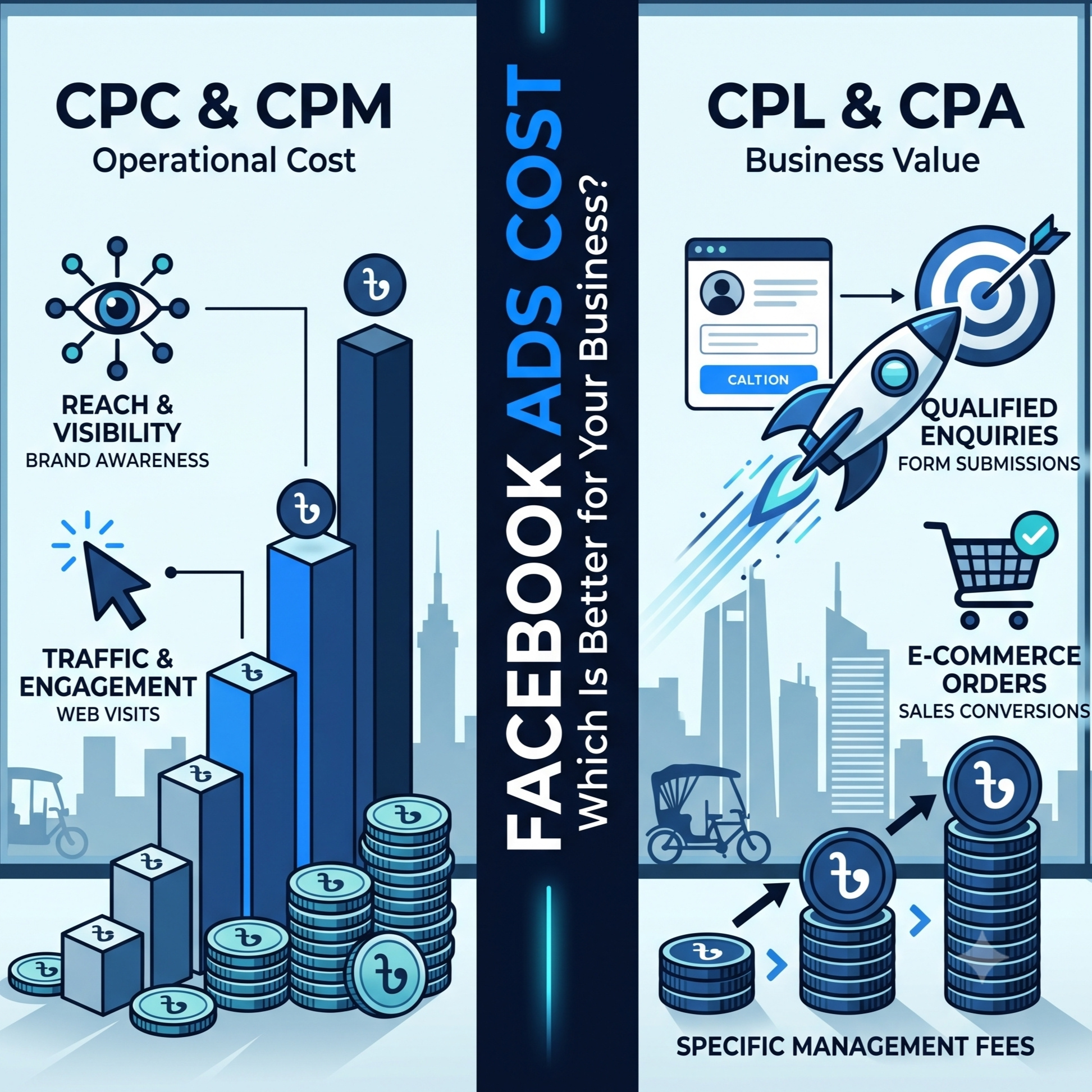
CPC, CPM, CPL and CPA: Which Metric Matters?
Different metrics answer different management questions.
Metric Calculation What It Explains CPM Ad spend ÷ impressions × 1,000 Cost of generating visibility CPC Ad spend ÷ clicks Cost of generating traffic CTR Clicks ÷ impressions How often impressions produce clicks CPL Total campaign cost ÷ leads Cost of generating enquiries Cost per purchase Total campaign cost ÷ purchases Cost of generating orders Customer acquisition cost Complete investment ÷ new customers Cost of acquiring paying customers ROAS Attributed revenue ÷ ad spend Revenue attributed to media spend Commercial return Gross profit ÷ complete campaign cost Business value after wider costs
CPM may be the primary operational metric for awareness campaigns, while CPL can be more relevant to a consultancy. An e-commerce company may monitor purchase cost and ROAS, but management should still account for product cost, delivery, returns, discounts and agency fees.
A campaign can report strong ROAS inside Ads Manager and still produce weak commercial value when margins are low or repeat purchase rates are poor.
Why Facebook Advertising Costs Vary
Campaign costs rarely increase because of one factor alone. They normally reflect a combination of market conditions and campaign decisions.
Audience Size and Competition
A narrow audience can be expensive when many advertisers compete for the same people.
For example, a business targeting senior decision-makers in a few Dhaka commercial areas may have a smaller auction pool than a consumer brand targeting adults nationwide.
However, broader targeting should not be used blindly. A wider audience is useful only when the offer, creative and conversion data allow the system to identify relevant customers.
Industry and Customer Value
Advertisers can often pay more when one customer has greater economic value.
A B2B software provider may accept a lead cost of several thousand taka when one successful contract generates substantial recurring revenue. A low-margin retailer may not be able to sustain the same acquisition cost.
This is why two companies should not copy each other’s budgets simply because they advertise on the same platform.
Campaign Objective
Awareness, engagement, traffic, leads and sales campaigns optimise toward different actions.
The CPM for an awareness campaign may appear affordable, but that does not mean the campaign will generate purchases. A sales campaign may have a higher CPM while producing more commercially useful outcomes.
Creative Quality and Fatigue
Strong creative can improve attention, communicate value and pre-qualify the audience.
Performance may decline when the same advertisement runs for too long or reaches the same people too frequently. Management should review frequency, conversion rate and creative-level performance rather than automatically increasing the budget.
Offer and Conversion Experience
Advertising cannot repair an uncompetitive offer.
Customers may ignore a campaign when the price, value proposition, delivery terms or credibility are weak. They may also abandon the process when a website is slow or the lead form requests too much information.
Media buying, creative and conversion experience must therefore support the same business objective.
Seasonality and Market Demand
Competition may rise around Eid, Ramadan, major shopping campaigns, admission periods and other commercially important events.
Advertisers entering a peak period should not assume that their normal CPC or CPM will remain unchanged. Budget planning should account for greater competition and the need for stronger creative differentiation.
Daily Budget vs Lifetime Budget
Meta allows advertisers to use daily or lifetime budgets.
A daily budget is the average amount the advertiser is prepared to spend each day. Meta currently explains that daily delivery can rise above the stated average when stronger opportunities are available, but weekly spending should not exceed seven times the daily budget. Meta’s pricing guidance says that spend may reach up to 75% above the daily promotional budget on an individual day.
For example, a BDT 1,000 daily budget does not guarantee that exactly BDT 1,000 will be spent every calendar day. The delivery system may spend more on one day and less on another while managing the weekly total.
A lifetime budget sets the total amount available across a defined campaign period. Daily spending may fluctuate, but the total should remain within the approved lifetime amount.
Daily budgets are often suitable for ongoing campaigns, while lifetime budgets may be useful for events, launches or time-limited promotions.
How Much Should a Bangladesh Business Spend?
The appropriate budget should be based on the required business outcome.
Management should begin by calculating an affordable acquisition cost.
Suppose a company earns BDT 20,000 in gross profit from an average new customer and is prepared to invest 20% of that amount in acquisition. Its maximum target customer acquisition cost would be BDT 4,000.
If only 25% of qualified leads become customers, the company can afford approximately BDT 1,000 per qualified lead.
If half of all enquiries are unqualified, the target cost per initial lead becomes approximately BDT 500.
This calculation creates a commercial boundary for the campaign team.
Affordable cost per customer = Customer gross profit × acceptable acquisition percentage
The team can then compare that boundary with actual CPM, CPC, conversion rate, lead quality and close rate.
Example Monthly Facebook Ads Budgets
The following scenarios are illustrations, not performance promises.
Local Service Campaign
A Dhaka-based service provider invests BDT 20,000 in media, BDT 8,000 in management and BDT 5,000 in creative production.
The complete monthly investment is BDT 33,000.
If the campaign produces 80 enquiries, the initial cost per enquiry is approximately BDT 413. However, management must determine how many enquiries came from the correct service area, matched the target customer profile and became paying customers.
If only ten of the enquiries are qualified, the qualified-lead cost becomes BDT 3,300.
E-commerce Growth Campaign
An online retailer invests BDT 80,000 in media, BDT 15,000 in management and BDT 15,000 in product creative.
The complete monthly investment is BDT 110,000 before applicable tax, payment and development costs.
If 150 purchases are attributed to the campaign, the complete cost per purchase is approximately BDT 733. That result may be profitable for a high-margin product but unsustainable for an item producing only BDT 300 in contribution per order.
The business should therefore review gross profit rather than platform-reported revenue alone.
Competitive B2B Campaign
A professional services company invests BDT 50,000 in media, BDT 18,000 in campaign management and BDT 12,000 in landing-page and creative improvements.
The complete investment becomes BDT 80,000.
If the campaign produces 25 leads, the initial CPL is BDT 3,200. If five leads become genuine sales opportunities and one becomes a BDT 500,000 contract, the economics may be commercially attractive.
For a B2B advertiser, opportunity value and completed revenue are more meaningful than raw lead volume.
Common Facebook Ads Management Fee Models
Fixed Monthly Retainer
A flat retainer provides predictable monthly costs.
It may suit a business with a stable campaign structure and clearly defined services. The scope should identify how many campaigns, creative variations, reports and meetings are included.
Percentage of Ad Spend
Larger accounts may use a fee calculated as a percentage of advertising spend.
This model can scale with the account, but the agreement should include a minimum fee and explain whether strategy, creative, tracking and reporting are included.
Setup Fee Plus Retainer
The first month may require substantially more work because the agency must audit assets, configure tracking, build audiences, structure campaigns and create initial advertisements.
A separate setup fee can therefore be reasonable when its deliverables are clearly documented.
Performance-Based Fee
Performance-based arrangements may be connected to leads, purchases or revenue.
They require accurate definitions and reliable attribution. The contract should explain what constitutes a valid lead, how cancellations and returns are treated and whether the performance calculation uses platform-reported or verified business data.
When a Small Budget Becomes Inefficient
A small budget can work when the campaign is focused.
Problems arise when BDT 10,000 is divided across awareness, traffic, leads, sales, several products and multiple audience groups. Each campaign may receive too little delivery to produce useful evidence.
Meta recommends allowing sufficient budget and duration for its system to learn. Its current public guidance recommends running with enough funding over at least seven days rather than evaluating performance from a very short test.
A limited budget should normally concentrate on one priority offer, one conversion action and the audience most likely to generate commercial value.
Additional products and funnel stages can be introduced after the business understands its initial acquisition economics.
How to Reduce Wasted Facebook Ads Spend
The first requirement is reliable measurement. Pixel and Conversions API events should be tested before the campaign is scaled.
The business should then review results by audience, creative, placement, location and conversion outcome. Cheap clicks should not be rewarded when they consistently fail to create qualified leads or purchases.
Creative testing should examine substantially different ideas rather than changing only one headline colour. Useful tests may compare product demonstrations, customer proof, founder-led content, direct offers and problem-based messaging.
The team should also separate prospecting from remarketing. Existing visitors and customers often behave differently from people encountering the company for the first time.
Finally, performance data should be connected with CRM, order and sales information. A campaign manager cannot optimise for lead quality when the company never reports which leads became customers.
Businesses requiring stronger attribution and performance reporting can explore Kaizen Digital Hub’s data analysis services in Bangladesh.
Boosted Posts vs Meta Ads Manager
Boosting a post can be suitable when the objective is limited exposure or engagement around an existing publication.
It is not a complete substitute for a structured acquisition campaign.
Ads Manager provides more control over objectives, conversion events, audiences, placements, creative variations, budgets and reporting. Businesses seeking leads or purchases should normally build campaigns around the actual business outcome rather than using engagement as the default objective.
A post with thousands of reactions can still fail to generate enquiries. Engagement is useful only when it contributes to a defined marketing purpose.
What Should Be Included in a Professional Proposal?
A Facebook advertising proposal should clearly show the media budget, management fee, creative cost and technical expenses.
It should describe the campaign objective, audience, platforms, deliverables, reporting schedule and approval process. The proposal should also identify services that cost extra, such as video production, influencer fees, landing pages and advanced tracking.
The business should retain access to its Page, Instagram account, ad account, billing records, Pixel or dataset and Business Portfolio.
Companies comparing providers should read how to choose a digital marketing agency in Bangladesh before selecting an agency based only on the lowest monthly quotation.
For a wider comparison of social media, SEO, paid advertising and multi-channel retainers, review the digital marketing cost in Bangladesh guide.
How Kaizen Digital Hub Approaches Meta Advertising
Kaizen Digital Hub begins with the commercial objective rather than a predetermined number of advertisements or boosted posts.
The initial review considers the target audience, customer value, priority offer, historical campaign data, creative resources, website condition and acceptable acquisition cost.
A local service campaign may require lead forms, click-to-message advertisements and geographic controls. An e-commerce campaign may require catalogue integration, Pixel and Conversions API events, product creative and revenue reporting. A B2B campaign may require a landing page, stronger qualification and CRM feedback.
Kaizen Digital Hub’s Facebook advertising services in Bangladesh connect campaign strategy, creative, targeting, tracking and reporting around measurable customer-acquisition outcomes.
Businesses that need connected organic content, community management and paid campaigns can also explore Kaizen’s social media marketing agency in Bangladesh service.
The objective is not to report the cheapest CPC or the highest number of reactions. It is to generate commercially relevant results at a cost the business can sustain.
Final Verdict
The Facebook ads cost in Bangladesh depends on the objective, audience, competition, creative quality, conversion experience and customer value.
Many small businesses may begin with BDT 10,000–30,000 in monthly media spend. Structured growth campaigns may require BDT 30,000–100,000, while established e-commerce, national and multi-campaign accounts may invest considerably more.
Management fees, creative production, landing pages, tracking and applicable payment or tax costs should always be separated from media spend.
CPC and CPM are useful operational metrics, but they do not determine profitability. The correct budget is the amount that generates enough qualified leads, purchases and customer data to support a reliable commercial decision.
Request a Meta Ads Plan from Kaizen Digital Hub to evaluate your audience, campaign objective, likely budget, creative requirements and measurement setup.
Frequently Asked Questions
How much do Facebook ads cost in Bangladesh?
Published 2026 Bangladesh guides report CPC ranges of approximately BDT 5–40 and CPM ranges of roughly BDT 80–300 for many campaigns. Actual costs depend on the objective, audience, creative, competition and conversion data.
What is a reasonable starting Facebook ads budget?
A focused small-business campaign may begin with approximately BDT 10,000–30,000 in monthly media spend. A sufficient test budget depends on CPC or CPM, conversion volume and the number of campaigns being tested.
Is the agency fee included in the ad budget?
Usually not. The media budget pays Meta for campaign delivery, while the agency fee covers strategy, setup, optimisation and reporting. Creative and tracking work may also be separate.
What is CPC in Facebook advertising?
CPC is the average amount paid for a selected click. It is calculated by dividing advertising spend by the number of clicks.
What is CPM?
CPM is the cost of generating 1,000 impressions. It is particularly useful when evaluating audience reach, competition and creative delivery.
Why is my Facebook CPC increasing?
CPC may rise because of greater competition, audience fatigue, narrow targeting, weaker creative, seasonality or a decline in click-through rate. The campaign should be evaluated through conversion and acquisition costs before changes are made.
Are Facebook and Instagram ads priced separately?
Campaigns for Facebook and Instagram are normally managed through Meta Ads Manager. Costs can differ by placement because audience behaviour and auction conditions are not identical.
Can Facebook ads guarantee sales?
No. Advertising can generate visibility and traffic, but sales also depend on the product, offer, pricing, website, checkout process and customer demand.