- info@kaizendigitalhub.com
- 151/6 Panthapath Signal, Gazi Tower (2th Floor)

Choose the Best Digital Agency in Bangladesh
21
Jul
Choose the Best Digital Agency in Bangladesh
Choosing the right digital marketing partner can influence your online visibility, lead quality, customer acquisition and long-term business growth. To choose digital marketing agency partners wisely, you need to look beyond attractive packages, social media followers and polished sales presentations.
The right agency should understand your business before recommending a service. It should identify the problems affecting growth, explain which marketing channels are suitable and show how performance will be measured. Communication, account ownership, reporting quality and realistic expectations are also important parts of the decision.
There is no agency that is automatically the best choice for every company. An agency that performs well for a large e-commerce business may not be suitable for a local service provider, startup, law firm or business-to-business organisation.
At Kaizen Digital Hub, we believe agency selection should begin with the business objective. Price matters, but strategic fit, relevant experience, service quality and measurable outcomes matter more.
This guide explains how to compare a digital marketing agency in Bangladesh, what questions to ask and which warning signs to notice before signing an agreement.
Key takeaway: The right agency is not always the cheapest, largest or most popular. It is the agency whose process, experience and capabilities match your goals.
Define Your Marketing Goals
Before comparing agencies, decide what you expect digital marketing to achieve. A statement such as “we need more promotion” is too broad because it does not identify the audience, desired action or expected business result.
A useful objective should explain who you want to reach, what action those people should take, which location you want to target and how success will be measured.
Business Goal Suitable Services Key Measurements Generate qualified leads SEO, Google Ads, landing pages Leads, conversion rate, cost per lead Increase online sales E-commerce SEO, ads, CRO Sales, revenue, ROAS Improve local visibility Local SEO, Google Business Profile Calls, directions, local visibility Launch a new business Branding, website, marketing strategy Enquiries, traffic, brand searches Improve website results UX, development, technical SEO Speed, leads, conversions Enter a new market Research, advertising, localisation Qualified traffic and acquisition cost
A campaign may generate hundreds of enquiries and still fail when the leads are irrelevant, outside the service area or unable to purchase. The agency should therefore understand what your business considers a qualified lead, booking, sale or conversion.
Without a clear objective, an agency may recommend activities that look impressive but do not solve the actual business problem.
Check Business Understanding
A professional agency should begin with discovery and research instead of immediately recommending a standard package.
During the first discussion, the agency should try to understand what your company sells, which services are most profitable, who your ideal customers are and how people currently discover your business. It should also ask about your service locations, sales process, competitors, previous campaigns, available budget and current marketing challenges.
The quality of these questions reveals whether the agency wants to understand your organisation or simply sell a predefined service.
For example, a company may believe it needs more website traffic when the actual problem is a confusing landing page. Another business may request Facebook advertising even though customers actively search for its service through Google. A capable agency should identify these differences before recommending a strategy.
At Kaizen Digital Hub, the initial discussion focuses on the business challenge, customer journey and expected outcome. This helps determine whether the priority should be SEO, advertising, website improvement, social media or several connected services.
Review Relevant Experience
Years in business can demonstrate stability, but they do not automatically prove that an agency is suitable for your project.
Relevant experience is more important than general experience. An agency should understand your business model, target market, customer type, marketing channels and project complexity.
An agency that mainly manages social media content may not have the technical experience required for a complex website migration. Similarly, a company that builds attractive websites may not understand conversion tracking, search intent or paid advertising.
Ask the agency whether it has worked with a similar business model. It should be able to explain the client’s original challenge, the services delivered, the problems encountered and the way success was measured.
The purpose is not to find an agency that has worked with every industry. The purpose is to confirm that its experience is relevant to the problem your business needs to solve.
Request Real Case Studies
A portfolio shows how a finished project looks. A case study shows how the agency approaches problems, develops a strategy and measures outcomes.
A useful case study should explain the client’s original position, business goal, challenges, strategy, implementation process and measurement period. The result should be supported by relevant evidence rather than vague claims.
Evidence may include qualified lead growth, online sales, organic search clicks, conversion-rate improvements, advertising cost reductions, website speed improvements, registrations or appointments.
Be careful when an agency presents a large percentage without explaining the original figure. A claim that traffic increased by 300 percent means little without the starting number, final number, traffic source and business outcome.
Increasing monthly traffic from 100 visitors to 400 is different from increasing it from 100,000 visitors to 400,000. Traffic growth is also less valuable when visitors do not become customers.
Case studies should use genuine and verifiable information. Rankings, leads, sales and revenue should never be invented simply to make a project appear successful.
Compare Service Capabilities
A full-service digital marketing agency may offer SEO, Google Ads, social media marketing, content, website development, e-commerce development, graphic design, mobile app development and analytics.
However, a long service list does not prove that the agency has equal expertise in every area.
Before hiring, clarify who performs each service, whether the work is completed internally and whether any part of the project is outsourced. You should also know who reviews the work, who manages the account and which services require additional charges.
Many digital projects involve more than one department. A Google Ads campaign may require a dedicated landing page, new graphics and conversion tracking. An SEO campaign may reveal website-development problems. A new company may need branding, website development and marketing planned together.
Kaizen Digital Hub combines marketing, design and technology services because these areas often support the same business objective. However, every recommended service should have a clear purpose. Adding more services does not automatically create a better strategy.
Review the SEO Process
SEO involves more than inserting keywords into articles. A professional process begins with business research, website analysis, search-intent research and keyword mapping.
The agency should determine which keyword belongs on which page. Broad commercial keywords normally belong on service pages, while cost, comparison, checklist and problem-based keywords belong on supporting articles.
For example, digital marketing agency in Bangladesh should target the main agency page. Digital marketing cost should target a pricing guide, while SEO versus Google Ads should target a comparison article.
This structure prevents several pages from competing for the same search intent. It also helps search engines understand the relationship between the main service page and its supporting content.
A complete SEO process may include technical auditing, landing-page optimisation, internal linking, local SEO, content planning, performance monitoring and conversion tracking.
At Kaizen Digital Hub, keyword research is connected with page purpose. The goal is not to place the same phrase on every page. The goal is to build a clear content structure where each page has a specific ranking objective.
Assess Advertising Skills
Paid advertising should be measured by what happens after a user clicks an advertisement.
A campaign may generate a high number of clicks without producing qualified enquiries or sales. A low cost per click does not automatically mean the campaign is successful.
The agency should understand audience research, campaign structure, keyword selection, negative keywords, conversion tracking, landing-page relevance, creative testing and budget allocation.
It should also be able to connect advertising activity with contact-form submissions, calls, WhatsApp enquiries, bookings, purchases or qualified leads.
Cheap leads can still be poor-quality leads. They may come from the wrong location, contain false information or have no intention of purchasing.
A reliable agency should therefore report more than impressions and clicks. It should explain how the advertising budget contributes to measurable business outcomes.
Check Website Expertise
Digital marketing will struggle when the website creates unnecessary friction.
Before recommending more traffic, the agency should review the website’s speed, mobile usability, navigation, service descriptions, contact forms, trust signals and calls to action.
A campaign may underperform because the landing page loads slowly, the advertisement does not match the offer or the form requests too much information. Visitors may also leave when the website lacks testimonials, clear pricing guidance or an obvious next step.
Sending more visitors to an ineffective page may increase marketing expenses without increasing revenue.
Kaizen Digital Hub treats website performance and marketing performance as connected areas. Before increasing traffic, the website should clearly explain the offer, work correctly across devices and guide visitors towards a measurable action.
Review Reporting Quality
A useful marketing report should help business owners make better decisions. It should not only display numbers.
The report should explain what work was completed, what changed during the reporting period, which activities produced results and what underperformed. It should also explain why performance changed and what the agency recommends next.
The most relevant measurements depend on the project. They may include qualified leads, calls, bookings, sales, conversion rate, revenue, cost per lead, advertising return, organic search clicks and customer acquisition cost.
Followers, impressions and engagement may provide useful context, but they should not replace business outcomes.
A dashboard displays data. A useful report explains what that data means for the company.
At Kaizen Digital Hub, reporting is intended to connect completed work with measurable progress and future priorities. When performance declines, the explanation should include what happened, what was learned and what will be changed.
Confirm Account Ownership
Your business should retain ownership or administrative access to its important digital assets.
These assets may include the domain name, website hosting, content-management system, Google Analytics, Google Search Console, Google Ads, Meta Business Manager, Google Business Profile and design source files.
An agency may manage these platforms, but your company should not lose access when the relationship ends.
Before signing an agreement, confirm which email address will own each account, what access level your business will receive and how data will be transferred. The handover process should also be documented.
Avoid arrangements where essential accounts exist only under the agency’s private ownership. Losing access to advertising history, analytics data or website files can create serious problems later.
Compare Pricing Clearly
Agency pricing varies because different providers include different levels of strategy, content, development, campaign management and reporting.
Two packages with the same name may contain completely different deliverables.
One SEO package may include only metadata changes, while another may include technical auditing, keyword mapping, landing-page work, content production, internal linking and monthly reporting.
A proposal should separate the agency fee, advertising budget, content cost, design cost, development cost, tracking setup and software expenses.
It should also clarify what will be delivered, how often the work will occur, what the client must provide and which services are excluded.
A lower quotation is not automatically better when important deliverables are missing. To choose digital marketing agency services correctly, compare scope and expected value rather than package names alone.
Review Communication Standards
Strong technical work can still fail because of weak communication.
Before hiring, confirm who will manage the account, which communication channels will be used and how frequently reports or meetings will occur.
The agency should also explain its approval process, expected response time and escalation procedure. Both the agency and the client should understand their responsibilities.
Reliable communication includes discussing negative performance honestly. When a campaign underperforms, the agency should explain what happened, which evidence supports the conclusion and what changes will be tested.
Transparent communication creates more trust than a report containing only positive numbers.
Avoid Unrealistic Promises
Be cautious when an agency guarantees the first position on Google, immediate SEO results, permanent rankings or a fixed level of sales.
Marketing results depend on competition, website condition, market demand, available budget, offer quality, content, technical implementation and sales follow-up.
An agency cannot honestly guarantee a specific outcome before reviewing the business and market.
Large backlink packages, guaranteed viral campaigns and identical promises for every company are also warning signs. A professional recommendation should be based on research rather than a standard sales script.
Realistic expectations do not mean the agency lacks confidence. They show that the agency understands the factors influencing performance.
Use an Agency Scorecard
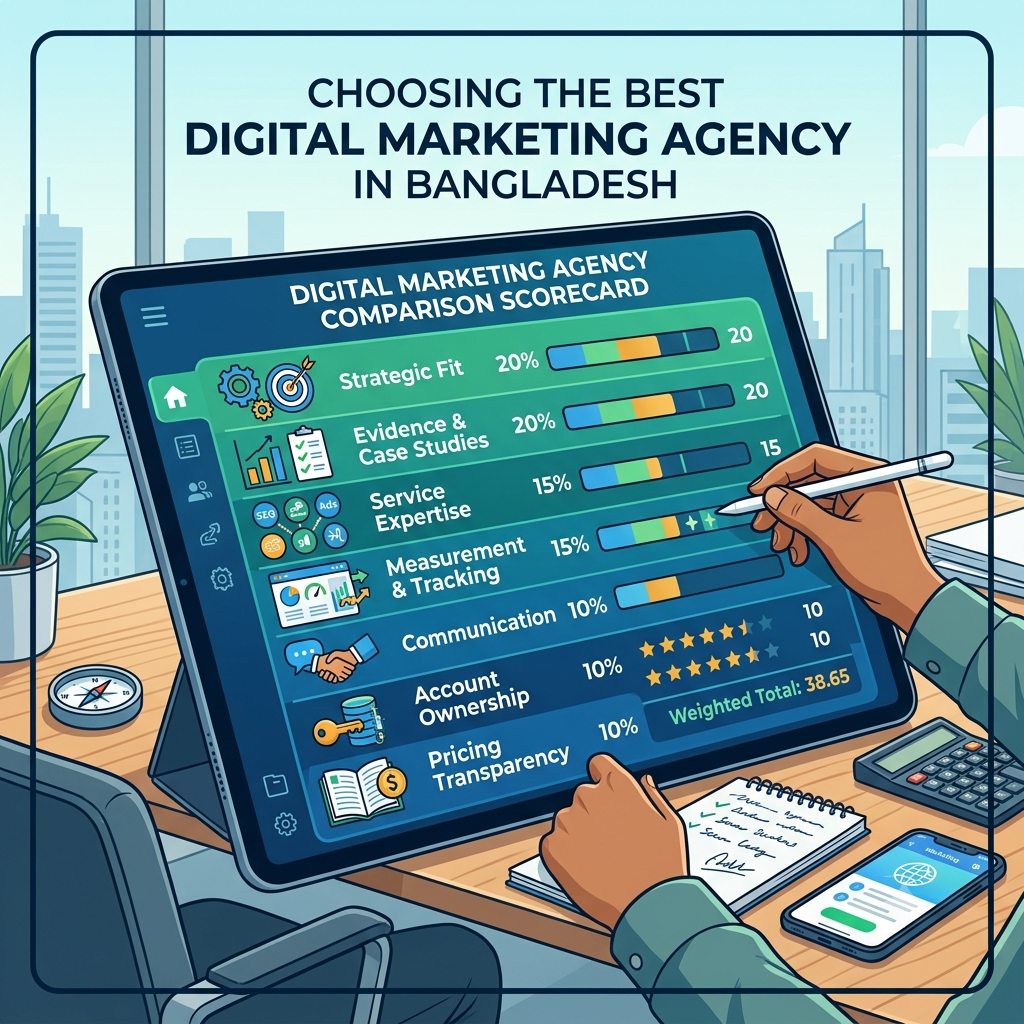
A structured scorecard can help you compare shortlisted agencies objectively.
Evaluation Area Weight What to Review Strategic fit 20% Does the strategy address the business goal? Case-study evidence 20% Are outcomes clearly documented? Service expertise 15% Does the team understand the required work? Measurement quality 15% Can leads, sales and value be tracked? Communication 10% Are reporting and approvals clear? Account ownership 10% Will the business retain its assets? Pricing clarity 10% Are scope and extra costs documented?
Give each agency a score from one to five for every area. Multiply the score by the assigned weight and compare the final totals.
This method reduces the risk of selecting an agency based only on price, popularity or presentation quality.
Review the First 90 Days
The first 90 days should establish a measurable foundation.
During the first month, the agency should review the business objectives, target audience, competitors, website condition, analytics, existing campaigns and tracking setup. This period may include discovery sessions, technical audits, keyword research and baseline reporting.
During the second month, the agency should begin implementing the highest-priority work. This may include landing-page improvements, campaign setup, technical fixes, content production, conversion tracking and creative development.
During the third month, early data should be reviewed. Search queries, lead quality, conversion rates and advertising costs should be analysed. The agency should then explain which activities will continue, which need improvement and what should happen during the next quarter.
The exact timeline depends on the website, project scope, competition and approval process. SEO normally requires more time to produce meaningful growth, while advertising may generate data sooner but still needs testing.
Notice the Warning Signs
Consider another provider when an agency recommends a package without understanding the business, refuses to explain its strategy or cannot show relevant work.
Other concerns include unclear pricing, copied content, missing conversion tracking and reports that discuss activities without explaining outcomes.
Exclusive ownership of accounts is another serious warning sign. Your company should not depend on an agency for permanent access to its own digital assets.
One concern may require clarification. Several warning signs together indicate a greater risk.
Ask Better Questions
Before making the final decision, ask the agency what it understands about your customers and which marketing channel should be prioritised.
Ask what will happen during the first 90 days, how qualified leads will be measured and who will perform the work.
You should also ask what is included in the price, who will own the accounts, how often reports will be provided and what happens when a campaign underperforms.
The answers should relate specifically to your business. Generic answers often indicate that the agency has not completed enough research.
Why Consider Kaizen
Kaizen Digital Hub provides connected marketing, design and technology services for businesses seeking better visibility, customer acquisition and digital performance.
Our service areas include digital marketing, SEO, paid advertising, social media marketing, website development, app development, graphic design and data analysis.
A business may require one specialised service or several connected services. For example, an SEO audit may reveal technical website problems. A paid advertising campaign may require a dedicated landing page and improved conversion tracking.
Kaizen Digital Hub begins with the business problem rather than forcing every client into the same package. The recommended approach depends on the business objective, available data, competition and website condition.
Make the Final Decision
Before selecting an agency, confirm that your goal is clear, the proposed strategy matches that goal and the agency can explain how results will be measured.
Review the agency’s experience, case studies, reporting process, pricing structure and account-ownership policy.
The right agency should do more than complete monthly activities. It should help your company understand performance, identify opportunities and make better marketing decisions.
To choose digital marketing agency partners successfully, focus on strategy, evidence, transparency and business fit.
Kaizen Digital Hub supports businesses through SEO, advertising, social media, website development, app development, graphic design and data analysis.
Request a Digital Marketing Consultation to discuss your current challenges and identify the services most relevant to your business.
Frequently Asked Questions
How do I choose an agency?
Compare the agency’s relevant experience, strategy, case studies, pricing, reporting, communication and account-ownership policies.
What should I ask first?
Ask how the agency understands your business, which services it recommends and how performance will be measured.
How much do agencies charge?
Pricing depends on the project scope, required services, competition, content, advertising budget and reporting requirements.
Can agencies guarantee rankings?
No reliable agency should guarantee permanent organic rankings or a specific sales result before analysing the business and competition.
Should I hire specialists?
A specialist may be suitable for one complex service. A full-service agency may be better when marketing, design and technology need to work together.
How long should selection take?
Take enough time to compare proposals, verify evidence, confirm ownership and understand what will happen during the first 90 days.